Best Practices for Adding a Second Service
Thinking of Adding a Second (or Third) Service? Tips, Considerations, and Encouragements.
One of the most difficult transitions a church can make is moving to multiple services. When done well, multiplying services has the ability to rally and unite a church together for an exciting kingdom cause. Or, if done or communicated poorly, it can divide, discourage, and drain the people of your church.
I don't claim to have done it well or be an expert on this in any way. I'm sure there are many fantastic articles and blogs on how to do this, but it's one of the questions I get asked the most about from fellow pastors. We're also currently exploring adding a third service so I thought it a good time to revisit what we learned about adding a second service.
By God's grace, our multiplication from one to two services was a positive experience that has led to health and growth in our church and, most importantly, reaching more people with the Good News.
Here's some of our story as well as tips and suggestions to help you if you're considering adding a service.
Our Story
I can't communicate the full story, but you can watch a 5-minute version of it HERE.
Our church, which had been around for sixty years, had always been a one service church and never had more than 80 people in average attendance before we arrived in 2015. The year before we arrived it averaged 48 people on Sunday mornings and was dwindling fast. So growth and expansion was new territory.
But as we consistently got into the hundreds, we started thinking ahead. Not counting COVID-impacted years, we have grown on average by 40% annually, so the writing was on the wall that we would soon run out of space in our fairly small (at that point) sanctuary. So, tip #1 is:
1. Plan Ahead
Even if it feels far away, you should start thinking about and planning (in faith) for when you will add another service. Hopefully you keep good statistics so you can monitor your growth trends. You should have a "trigger point" in mind already of when you would start moving toward adding a service. That obviously will depend on the size of your meeting space.
The well-known "rule" is that once you reach 70-80% capacity in your space, you are out of room. Because we planned ahead, we were ready to start moving as soon as we reached 75% capacity.
That doesn't mean you will immediately add a second service once you hit that capacity. In fact, I think it's a good idea for people to feel the discomfort of being overcrowded and experiencing the lack of space and parking for a few months. It will make it easier to convince everyone of the need (or you won't even have to convince them). But you'll already have been planning behind the scenes well before you hit that 70-80% mark because once you do, it's time to act fairly quickly.
2. Cast Vision & Encourage Faith
Almost nothing is more important than how you cast vision and communicate what's happening with your church.
As with all vision casting, the key is always starting with the "why" more than the "how." People will naturally want to know how we will do this or that (which we'll get to). But first you must convince them of why. Give the statistics, show the growth trajectory, and don't be afraid to communicate this is a regular part of being a Great Commission church. This should be the norm!
Frequently communicate that God is the author of the growth and will therefore be the author of the resources needed to support the growth. This is God's idea! God is adding the numbers and will supply the need. This is not something we have to do, rather it is something God is inviting us to participate in. If God is sending people, we need to make room!
The only alternative is to stop growing and to essentially turn people away.
People are willing to do things that are difficult, and even do them joyfully, if they find them meaningful and worthwhile. It's not convenient to move to multiple services, but the gospel isn't always convenient! Growing and multiplying is hard work and requires greater participation from everyone. But making new disciples is a part of the mission of the church and that goes hand in hand with growth. Comfortable Christians don't change history.
So make sure people's first question isn't "how will this affect me? Is this good or bad for me?"
For the most part the church will love growing, so speak into the vision of what's happening. Explain that this is not a loss, but a gain. This is like planting a new church and is something to rejoice about! We get to be a part of something groundbreaking. Which leads us to the next suggestion:
3. Focus on the Benefits
It's easy to focus on all the things that will be harder or might be lost in the transition to two services. But it's important to emphasize all the benefits and positives. There are so many, but here's just two examples of things to communicate to your church or your staff.
1) You can care for people better.
I find that about 200 people per service is the max I can do and still say hello to almost everyone, meet every guest, and be able to look out and see who's there and who's not.
Therefore, having multiple services of slightly smaller groups is preferred from a pastoral perspective. This applies to kids ministry as well where your leader to kids ratio will improve immediately.
But this also applies to the average parishioner. Going to two services keeps each service more intimate and keeps the "family feel" that people want from a church. I believe that it way better serves your church and community to have multiple services than to build a 1,000 seat sanctuary.
We're now a "big" church that almost 1,000 people call home, which is about 2-4% of our population depending on where you make the cutoff. But people constantly comment on the intimate, family feel that they experience here. We don't look, feel, or act like a big church.
2) Who Doesn't Love Options?!
If you want to serve your community well and reach people, the more options you give them the better. Most studies consistently show a church will experience almost an immediate 20-30% bump in attendance when they add a service. Why? First, I believe God responds to our faith and sends people. But on a practical level, having more time options helps.
Once we moved to 9am & 11am, many people commented how having an earlier service option would allow them to attend and still make it to their kids' soccer or baseball game, get to work on time, sleep in, go to their family outing, etc. I know the ideal is people prioritize and protect their Sunday mornings, but you have to be realistic about the culture we live in and what you can expect, especially from pre-Christians.
A great example is our Christmas Eve services. Over the years our Christmas Eve attendance has jumped from 78 to over 700 as we found the more options we gave people, the more people we reached. As much as I wish everyone prioritized corporate worship above all other activities on Christmas Eve, they are planning other get-togethers. Once we started giving people multiple options form morning to night, we were able to engage more people in the thing that matters most at Christmas: worshipping Jesus.
We live in a culture not inclined to come to church, so we should remove every possible barrier within our power. We likely have to work harder than any generation in Canadian history to make church a viable option for people. Embrace the challenge!
Those are some of the most important, big picture items. But here's some lists of other things to consider that I hope will help you and your church.
Communication Tips (to your church)
- Create a "Frequently Asked Questions" document that anticipates people's questions or concerns and/or have a "town hall" style Q&A. This shows them that you're thinking things through and considering what people might be feeling or thinking. Bring them along on the journey!
- Make it fun! I started creating a "Top 5" for each of the two services that comically highlighted the advantages of each. (sort of like this "Top 5 Reasons to Wear a Mask to Church" video we made during COVID - might as well have fun with it!). Or have skits or competitions leading up to the service addition.
- Let them know the values and DNA of your church won't change, just the number of services.
- Emphasize they will be the exact same service: neither one has more or less music, preaching, ministry time, prayer time, etc. (see practical considerations below).
- Highlight the opportunity for volunteers to serve in one service and fully participate in the corporate worship in the other. That's not possible with one service and is a big gain that we've seen lots of people take advantage of.
- Highlight the time between the services as a time to fellowship and encourage people to come early or stay late (if your parking can handle it! The general rule is about 3 people per parking spot). It's a great way to greet and get to know those who are in a different service.
- Related, be sure to promote all the other ways people can stay connected and in close relationship such as life groups, serving together, prayer services, etc. People are often concerned about losing friendships, but there are so many more ways to connect outside of Sunday morning.
- Promote that it will lessen the stress on volunteers (at least initially). Right now your greeters, kids workers, and coffee volunteers are serving a packed house and it can feel a little overwhelming or chaotic. Two services will initially provide an easier pace and softer entry point for new volunteers.
- Come up with a catchy or memorable slogan that is Scripturally grounded. As a part of the vision launch announcing two services, I preached a message called "It Takes Two . . . to Reach the One" emphasizing Jesus' concern for the one (Luke 15, etc.). I know of another pastor who used John 12:24: "unless a kernel of wheat falls to the ground and dies, it remains only a single seed. But if it dies, it produces many seeds." There should be a gospel-infused, Scripturally-inspired picture of why you are multiplying. Help people's theological imagination come alive!
- Overall, this is not a loss, but a gain. The only loss would be staying at one service, which would most impact those who are only moderately, casually, or not connected with your church. In other words, potential disciples! Those are the people who are likely to turn around if they can't find parking or a seat, or not even show up if they're running late because they know there might be no room left for them.
Communication Tips (to your staff)
- Be up front that you know you're asking everyone to stretch for a season. It will be hard at first, but eventually you'll settle into a routine. Communicate that you'll do this together and walk alongside them.
- Assure staff that you understand we'll have to cut back in some other areas or put some other projects on the back burner. Have a meeting with each staff member to help them focus their portfolio and create a safe space where they can honestly express concerns about their capacity. Work with staff on where the extra hours put into the extra service(s) will be given back. Friday/Saturday are our days off as staff. But one big change we made when we went to two services was making Monday a work from home day so that you didn't have to come right back after a long day. Also any staff who preach or lead music in both services automatically can take a half day off on Monday without asking.
- The first service can feel like a rehearsal for the second. Don't let that happen! Conversely, don't lose focus or become too loose in the second service just because there's no time considerations. Bring the same focus and energy to each service no matter the size, feel, etc. Once you first multiply, it's likely one service will be quite smaller than the other, but avoid the temptation to be less focused--those people deserve the same energy from you!
- Make sure everyone is on the same page regarding terminology. Make sure staff never say the church is going to "split" or "divide" into two services but rather "multiplying."
- Prepare your team that you might lose some people and they may lose some volunteers. Change is hard for people. But moving forward, everyone who joins your church will only know two services and will embrace it.

Practical Considerations & Questions to Ask
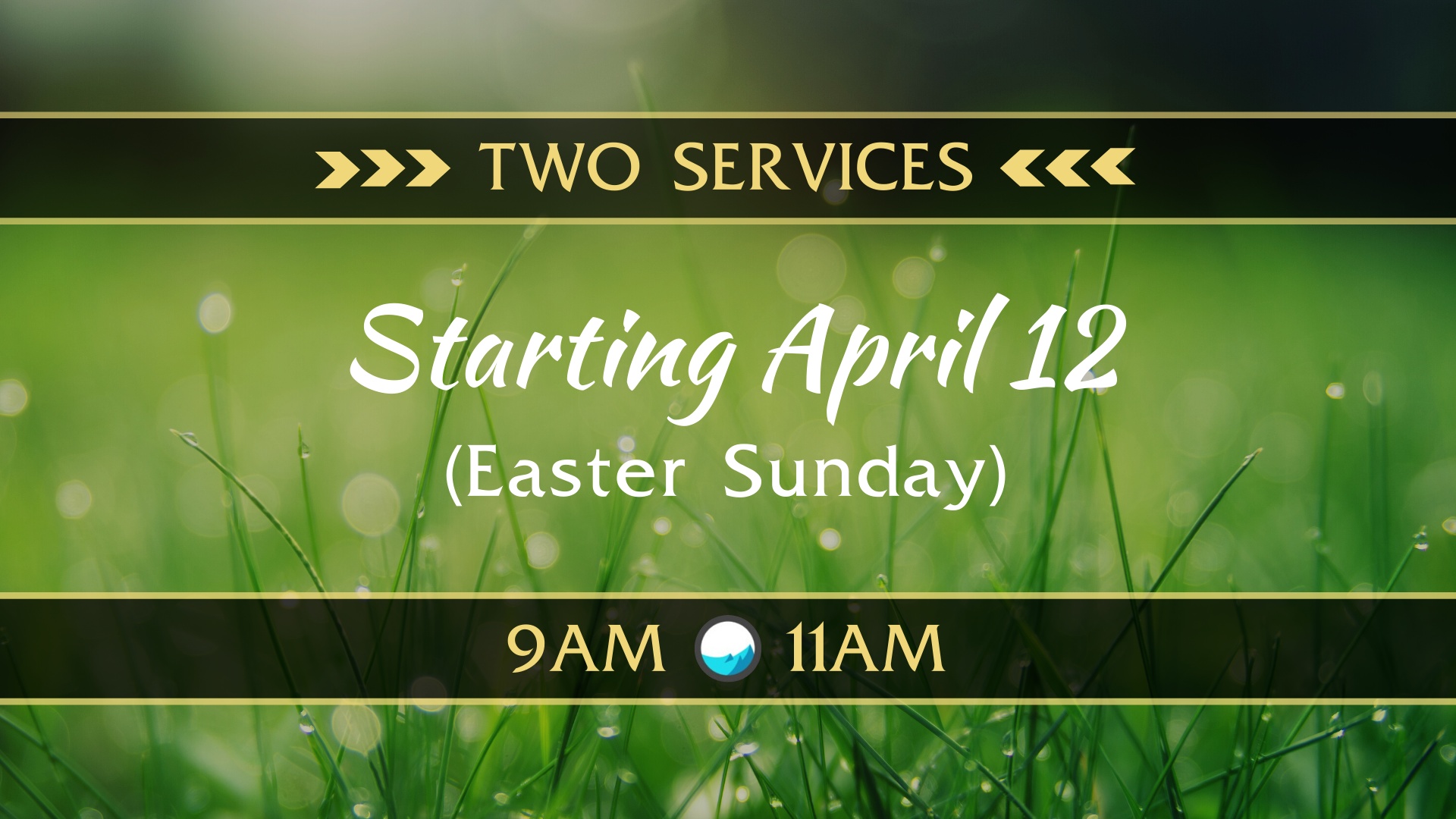
- When will you launch? Common opinion is to pick one of the built-in attendance bumps in the year such as Easter, late Fall, or January. Set a launch date far in advance and begin letting people know! As shown in the two slides above, we let people know for months it was "coming soon" and then eventually revealed a launch date.
- What will your two times be? 9 & 11 is most popular because it tends to work and creates the most balanced attendance. Anything before 9 feels pretty early and after 11 quite late. Being a church that likes to allow space and time at the end for prayer, response, and ministry time, I find 90 minutes between times to be too short, but it works for some.
- Will you rope off any sections in the lesser attended service?
- Will both services be the exact same? My suggestion is to make sure it's a resounding yes so that people truly have two options and don't feel like one service is "less than." I know a lot of churches begin with one service being the "family service" with full kids program and the other no kids church in order to lessen the load on staff or volunteers. But I don't think that sets you up to continue to grow well, and consistency is key.
- Preparing and adjusting your Church Management System (Planning Center, etc.) for two services, scheduling volunteers, etc. will be one of the more difficult transitions sometimes. Assign your best tech person to head up the job and make sure someone knows all the ins and outs of how it will work. If that has to be you as the Lead Pastor, embrace it and become the expert!
- Create a rest and snack area for your volunteers who participate in both services (musicians, tech, etc.). There's not a lot of extra space in our building, so we just labeled a little corner of the kitchen the "two service volunteer rest/snack area" and kept it stocked with protein bars, waters, etc. It's a small gesture, but people appreciate it.
- For most situations, adding your second service back-to-back in the morning is the easiest transition and allows you to utilize your volunteer resources the best. People are more likely to commit to one focused time for 3-4 hours than two separate time blocks (such as a morning and an evening). A third service, as we're now considering, may be a different story (see the "people love options" point above).
- You will have to tighten up your services a bit. Where will you cut? This is a great chance to simplify your services and cut out unnecessary things that aren't essential but that you maybe did simply because you had time. And of course, you'll probably need to preach shorter messages!
NEWSLETTER SIGNUP (blog post layout)
ABOUT JOSEPH
Pastor, Author, and sometimes pretends to be a Scholar
Joseph (PhD, University of Birmingham) is the author of The Pentecostal Gender Paradox: Eschatology and the Search for Equality.
Since 2015, he and his wife have together pastored Oceanside Community Church on Vancouver Island, where they live with their four children.
RECENT BLOGS